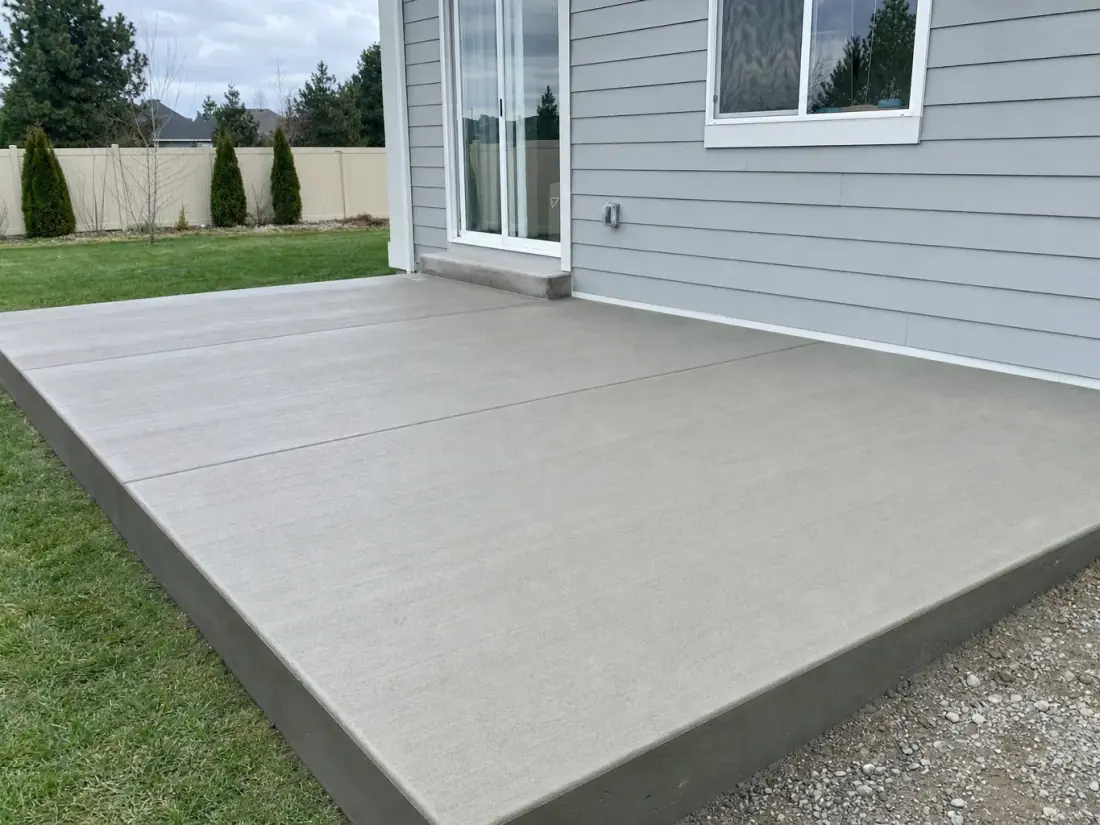
Concrete Patios in Spokane Valley, WA — What to Expect
A patio has to shed water away from the house. That sounds obvious and it is the thing most often got wrong. A patio poured dead level, or worse pitched back toward the foundation, sends every rainstorm and every snowmelt into the wall it abuts.
We set fall away from the structure, isolate the patio from the foundation with an expansion joint so the two can move independently, and detail the edges so they do not spall at the first hard freeze.
Finish changes the feel more than the cost. A broom finish stays grippy underfoot in wet weather; a smooth trowel finish looks cleaner and gets slick. We will tell you which suits how the space actually gets used.
What Is Included
- Positive fall away from the structure
- Expansion joint isolating patio from foundation
- Compacted base with thickened edges
- Slip-appropriate finish for a wet climate
- Control joints laid out to the slab geometry
Our Process for Concrete Patios
- 1
Step 1: Layout and Fall Planning
The patio is marked out and the fall away from the house established before anything is dug, because drainage direction is the decision everything else follows.
- 2
Step 2: Excavation and Base
Ground is excavated to depth and compacted aggregate base placed, with the edges thickened where the slab will take load or abut soft ground.
- 3
Step 3: Forms, Isolation and Reinforcement
Forms are set to the planned fall, an expansion joint isolates the patio from the house foundation, and reinforcement is placed within the slab depth.
- 4
Step 4: Pour and Finish
Concrete is placed, screeded and finished to the chosen texture. Finish is chosen for grip in wet weather, not only for looks.
- 5
Step 5: Joints, Curing and Sealing
Control joints are cut on the planned layout, the slab is cured, and a sealer is applied where the finish calls for one.
Concrete Patios We Offer in Spokane Valley
Standard Concrete Patios
Plain broom or trowel finish, the most economical way to create usable outdoor floor area.
Stamped and Coloured Patios
Textured and pigmented to read as stone or slate while staying a single monolithic slab with no joints to weed.
Patio Extensions and Additions
Extending an existing patio, which needs an isolation joint and careful matching so the new work does not simply crack away from the old.
Covered Patio and Pergola Slabs
Slabs designed with post footings and anchor placement built in from the start rather than drilled in afterwards.
Why We Are the Concrete Contractor to Call in Spokane Valley, WA
Drainage designed in, not added on
Nearly every failed wall in this region failed because water had nowhere to go. Drainage stone, filter fabric and outlets are part of the design, never an upsell.
We tell you when you need an engineer
Walls over four feet, surcharged walls and tiered walls generally need stamped drawings. We say so up front rather than building something that fails inspection.
Built for freeze-thaw
Inland Northwest winters move soil hard. Base depth, compaction and backfill are specified for frost, not copied from a warm-climate detail.
Written scope before work starts
Wall height, block type, drainage detail, geogrid layout and backfill material, all in writing. You can put it out to competitive bid.
Slope and erosion work, not just walls
Sometimes the right answer is regrading, terracing or planting rather than a taller wall. We will tell you when that is cheaper.
Clean sites, real restoration
Excavation spoil hauled away, access routes protected, and the lawn put back. Wall work is heavy and messy — the cleanup is part of the job.
Concrete Patios FAQs
Does a patio need to slope?
Yes, always away from the house. Level looks correct and drains nowhere, and a patio pitched back toward the building feeds water into the wall at every rainfall and snowmelt.
Concrete patio or pavers?
Concrete is cheaper per square foot and gives an uninterrupted surface. Pavers cost more but tolerate frost movement without cracking and individual units can be lifted and reset. Both are good in this climate for different reasons.
Will my patio crack?
Some fine cracking is normal in any slab. Control joints concentrate it where it will not be conspicuous. Wide cracks that offset vertically mean ground movement rather than shrinkage and are a different conversation.
Can you pour a patio right against the house?
Yes, with an expansion joint separating the two so they can move independently, and with the slab set below the siding or weep screed line so it does not trap water against the wall.
How long until I can use it?
Foot traffic after a day or two. Furniture after about a week. If the finish is being sealed, allow the sealer its own cure time before putting anything heavy on it.
Other Services in Spokane Valley
- Paver DrivewaysPermeable and standard paver driveways built to vehicle loading, on a considerably deeper base than a patio needs.
- Fire Pits and Seating WallsBuilt-in fire pits, seating walls and outdoor kitchens that turn a patio into a space people actually use.
- Stamped and Decorative ConcreteStamped, stained and coloured concrete that gets the look of stone or paver without the joints and the weeds.