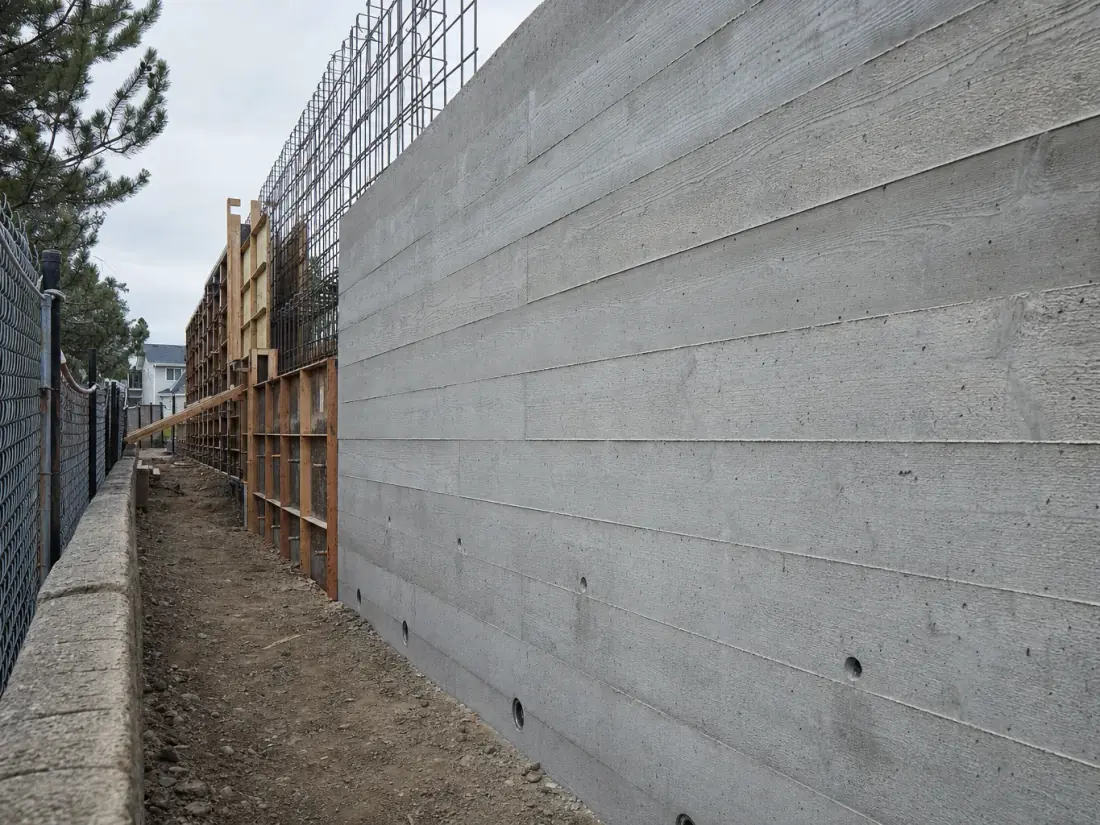
Poured Concrete Retaining Walls in Spokane Valley, WA — What to Expect
Poured concrete is the system for situations segmental block cannot handle: very tall walls, walls carrying substantial surcharge, and sites where there is no room behind the wall for the geogrid a reinforced block wall would need.
A cantilever concrete wall resists overturning through its footing rather than through mass or soil reinforcement, which is why it can work on a tight property line where nothing else will.
Forming, steel placement and pour sequencing all matter, and so does drainage — a concrete wall is impermeable, so water behind it has to be given a route out.
What Is Included
- Cantilever and gravity designs
- Reinforcing steel to engineered schedule
- Footing sized for overturning and bearing
- Weep holes and drainage behind the face
- Suits tight property lines and high surcharge
- Formed finishes or veneer-ready face
Our Process for Poured Concrete Retaining Walls
- 1
Step 1: Design and Footing Sizing
The footing is sized for overturning, sliding and bearing on your soil. A cantilever wall resists through its footing, so this is the calculation the whole wall depends on.
- 2
Step 2: Excavation and Footing Pour
The footing trench is excavated below frost depth, reinforcing steel placed, and the footing poured with dowels left projecting for the stem.
- 3
Step 3: Formwork and Steel Placement
Wall forms are set and braced, and the reinforcing cage is tied in place with correct cover to the face. Form alignment now is the finish you get later.
- 4
Step 4: Wall Pour and Consolidation
Concrete is placed in lifts and consolidated so there are no voids or honeycombing against the form face, particularly around congested reinforcement.
- 5
Step 5: Stripping, Drainage and Backfill
Forms come off once strength allows, drainage and waterproofing are applied to the retained face, and backfill is compacted in lifts against a wall that has cured enough to take it.
Poured Concrete Retaining Walls We Offer in Spokane Valley
Cantilever Retaining Walls
The standard reinforced concrete wall, resisting overturning through a footing that extends back under the retained soil.
Gravity Concrete Walls
Mass concrete walls resisting through sheer weight, used at lower heights where the footing space for a cantilever is not available.
Basement and Foundation Retaining Walls
Walls doing double duty as building structure and earth retention, where waterproofing and drainage detailing matter even more than usual.
Board-Formed and Architectural Finishes
Concrete walls where the face is a visible finish, formed to leave a deliberate texture rather than being clad afterwards.
Why We Are the Retaining Walls Contractor to Call in Spokane Valley, WA
Drainage designed in, not added on
Nearly every failed wall in this region failed because water had nowhere to go. Drainage stone, filter fabric and outlets are part of the design, never an upsell.
We tell you when you need an engineer
Walls over four feet, surcharged walls and tiered walls generally need stamped drawings. We say so up front rather than building something that fails inspection.
Built for freeze-thaw
Inland Northwest winters move soil hard. Base depth, compaction and backfill are specified for frost, not copied from a warm-climate detail.
Written scope before work starts
Wall height, block type, drainage detail, geogrid layout and backfill material, all in writing. You can put it out to competitive bid.
Slope and erosion work, not just walls
Sometimes the right answer is regrading, terracing or planting rather than a taller wall. We will tell you when that is cheaper.
Clean sites, real restoration
Excavation spoil hauled away, access routes protected, and the lawn put back. Wall work is heavy and messy — the cleanup is part of the job.
Poured Concrete Retaining Walls FAQs
Why choose poured concrete over block?
Three situations mainly: tall walls, heavy surcharge loads, and tight property lines where there is no room behind the wall for the geogrid a reinforced block wall would need. A cantilever wall works within its own footprint.
How long before I can backfill?
Concrete needs to reach adequate strength first, which is a matter of days rather than hours and depends on temperature. Backfilling a green wall is a good way to crack or move it, so it is not a step worth rushing.
Do poured walls crack?
Fine shrinkage cracking is normal in any concrete and is not structural. Control joints are placed to concentrate it where it will not be conspicuous. Wide, offset or growing cracks are a different matter and worth looking at.
Does a concrete wall need drainage?
More than a block wall, not less. Concrete is impermeable, so water behind it has nowhere to go unless you give it a route. Drainage stone, a collector pipe and weep holes are all part of the design.
Can a poured wall be finished to look better?
Yes. Board-forming, form liners, exposed aggregate and stone veneer are all options. Deciding before the pour is much cheaper than deciding afterwards, since the formwork does most of the work.
Other Services in Spokane Valley
- Retaining Wall InstallationNew retaining walls built to the right height, base depth and drainage detail for your slope and soil.
- Retaining Wall RepairLeaning, bulging and cracked walls diagnosed and repaired — starting with why it moved.
- Retaining Wall ReplacementFull removal and rebuild of failed walls, with the drainage and reinforcement the original lacked.