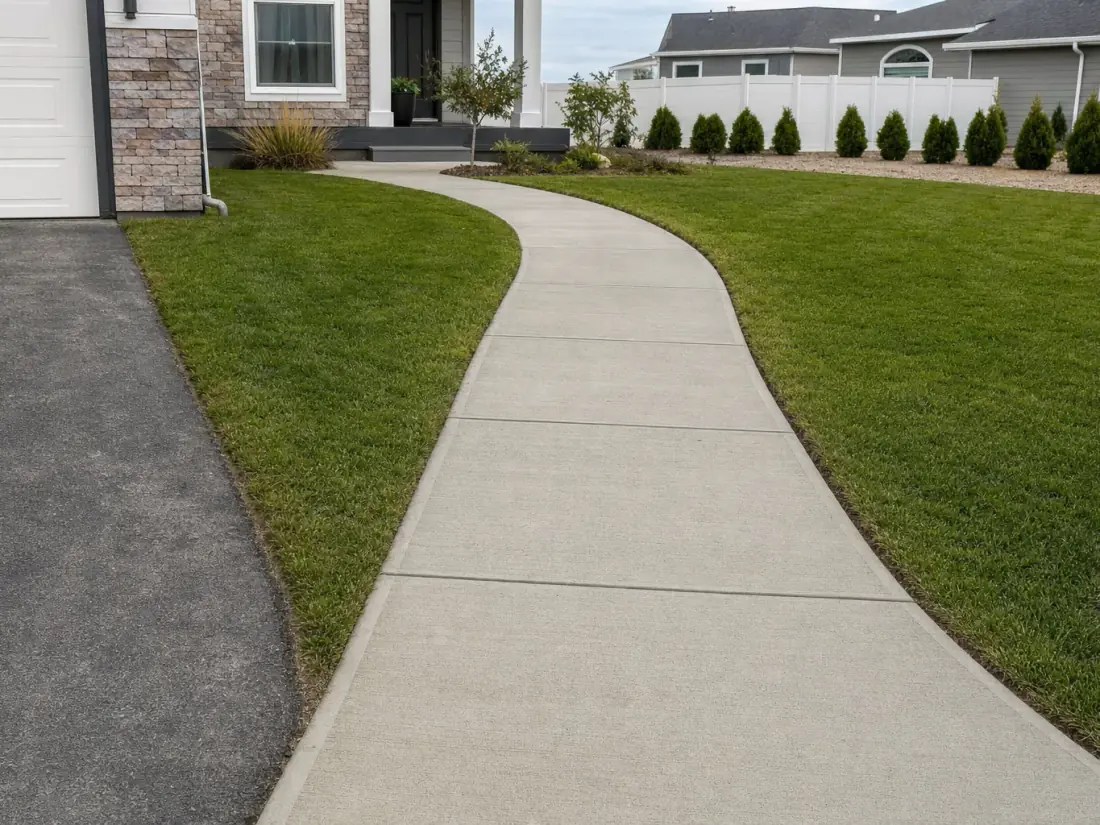
Concrete Sidewalks and Walkways in Spokane Valley, WA — What to Expect
Walkways look like the simplest concrete there is, and they generate more trip-hazard complaints than anything else poured. Width, cross-slope and joint spacing all matter, and public sidewalk work has to meet municipal standards for each.
Where the walkway is a public sidewalk or a commercial access route, running slope and cross-slope are regulated and inspected. We build to those limits rather than by eye.
Root heave is the other Inland Northwest reality. Mature trees lift slabs, so on established lots we will discuss root barriers or a realigned path rather than pouring something that lifts again in five years.
What Is Included
- Correct width, running slope and cross-slope
- ADA-compliant detailing where required
- Municipal standards met on public sidewalk work
- Root heave assessed on established lots
- Broom finish for wet-weather grip
Our Process for Concrete Sidewalks and Walkways
- 1
Step 1: Route Layout and Slope Check
The path is marked and both running slope and cross-slope are checked against what the use requires, which is a regulated limit on public sidewalk and accessible routes.
- 2
Step 2: Excavation and Root Assessment
The route is excavated and any tree roots crossing it are assessed. On established lots this is where we discuss root barriers or a realigned path.
- 3
Step 3: Base and Formwork
Compacted base is placed and forms are set, including any curves. Radius work is formed properly rather than faked with short straight segments.
- 4
Step 4: Pour and Broom Finish
Concrete is placed, screeded and given a broom finish across the direction of travel, which is what provides grip when the surface is wet or icy.
- 5
Step 5: Jointing and Edge Detailing
Control joints and tooled edges are formed at the correct spacing, both for crack control and because a tooled edge resists chipping far better than a sawn one.
Concrete Sidewalks and Walkways We Offer in Spokane Valley
Residential Walkways and Paths
Front paths, side access and garden routes, sized for comfortable two-abreast walking where space allows.
Public Sidewalk Construction and Replacement
Sidewalk in the right-of-way, built to municipal standards and inspected accordingly.
ADA-Compliant Accessible Routes
Paths meeting regulated running slope, cross-slope and surface requirements, including detectable warnings where required.
Trip Hazard Repair and Slab Levelling
Correcting lifted or settled sections, often from root heave, either by grinding, replacing the panel or lifting the slab.
Why We Are the Concrete Contractor to Call in Spokane Valley, WA
Drainage designed in, not added on
Nearly every failed wall in this region failed because water had nowhere to go. Drainage stone, filter fabric and outlets are part of the design, never an upsell.
We tell you when you need an engineer
Walls over four feet, surcharged walls and tiered walls generally need stamped drawings. We say so up front rather than building something that fails inspection.
Built for freeze-thaw
Inland Northwest winters move soil hard. Base depth, compaction and backfill are specified for frost, not copied from a warm-climate detail.
Written scope before work starts
Wall height, block type, drainage detail, geogrid layout and backfill material, all in writing. You can put it out to competitive bid.
Slope and erosion work, not just walls
Sometimes the right answer is regrading, terracing or planting rather than a taller wall. We will tell you when that is cheaper.
Clean sites, real restoration
Excavation spoil hauled away, access routes protected, and the lawn put back. Wall work is heavy and messy — the cleanup is part of the job.
Concrete Sidewalks and Walkways FAQs
How wide should a walkway be?
Three feet works for a single person, four feet lets two walk comfortably side by side, and public sidewalks have minimum widths set by the municipality. The extra foot is a small cost at pour time and very noticeable in use.
Who is responsible for the sidewalk outside my house?
It varies by jurisdiction, and in many places the adjacent property owner carries maintenance responsibility even though the sidewalk sits in the right-of-way. It is worth confirming locally before assuming either way.
Can you fix a raised sidewalk without replacing it?
Often. Grinding removes small lips, and slab lifting can raise a settled panel back to level. Where a root has lifted a panel substantially, replacement plus root treatment is usually the durable answer.
Why is my walkway cracking near the tree?
Roots thicken as the tree grows and lift whatever sits above them. Cutting the roots can destabilise the tree, so the usual options are a root barrier, a realigned path, or a flexible paver section that can be reset.
Do walkways need reinforcement?
Light reinforcement or fibre helps control cracking, though joint spacing does more of the work on a narrow slab. What matters most is a properly compacted base, since narrow slabs are unforgiving of soft spots.
Other Services in Spokane Valley
- Drainage and GradingYard drainage, French drains and regrading that move water away from walls, patios and foundations.
- Outdoor Steps and StairwaysStone, block and paver stairways connecting terraced levels on sloped Inland Northwest lots.
- Fire Pits and Seating WallsBuilt-in fire pits, seating walls and outdoor kitchens that turn a patio into a space people actually use.