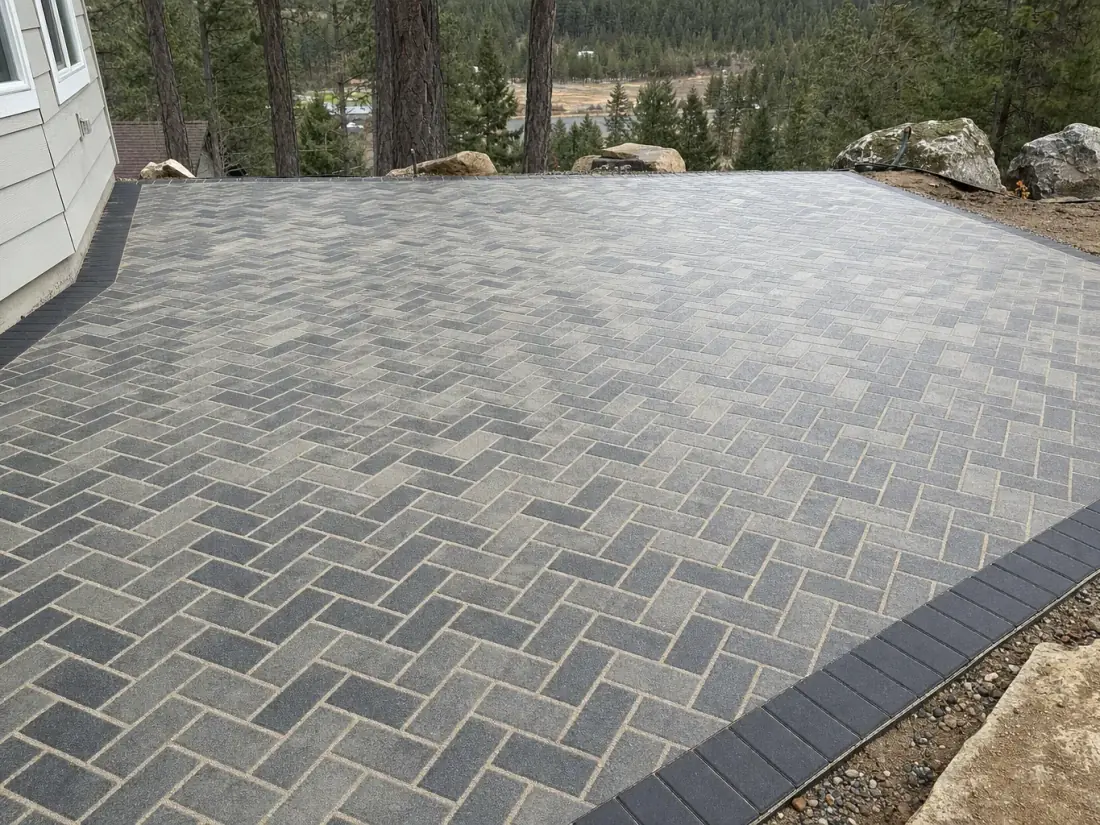
Paver Patios and Walkways in Spokane Valley, WA — What to Expect
Pavers live or die on the base beneath them. A paver patio is a flexible pavement, meaning the units move slightly and that is by design, but only if they sit on compacted aggregate of the right depth with a bedding layer of consistent thickness.
The advantage over poured concrete in this climate is that pavers tolerate ground movement. Frost heave lifts and settles a paver field without cracking it, and individual units can be lifted and reset if something does shift.
Edge restraint is what stops the whole field spreading outward over the years. It is invisible once installed and it is the component most often skipped on a cheap job.
What Is Included
- Compacted aggregate base cut to depth
- Screeded bedding layer of consistent thickness
- Edge restraint on all open sides
- Polymeric sand jointing
- Pattern laid out to minimise cuts
- Individual units resettable if ground moves
Our Process for Paver Patios and Walkways
- 1
Step 1: Layout and Pattern Planning
The area is set out and the laying pattern planned from a chosen start line, so cuts land where they are least visible rather than across the middle.
- 2
Step 2: Excavation to Depth
Excavation goes considerably deeper than people expect, because base depth plus bedding plus paver thickness all sit below the finished surface.
- 3
Step 3: Base Placement and Compaction
Aggregate base is placed and compacted in lifts. Compaction in a single pass leaves a base that settles later and takes the pavers with it.
- 4
Step 4: Screeding and Laying
A bedding layer is screeded to consistent thickness and pavers are laid to the pattern, kept to line as the field progresses.
- 5
Step 5: Edge Restraint, Sand and Compaction
Edge restraint is installed on every open side, polymeric sand swept into the joints, and the field plate-compacted to lock the units together.
Paver Patios and Walkways We Offer in Spokane Valley
Paver Patios
Outdoor living areas in interlocking concrete or natural stone units, laid on a flexible base that tolerates frost movement.
Paver Walkways and Garden Paths
Narrower runs connecting spaces, where edge restraint matters even more because there is less field to hold itself together.
Permeable Paver Systems
Open-jointed systems letting water drain through into an open-graded base rather than running off to the street or toward the house.
Paver Repair and Re-levelling
Lifting and resetting settled or heaved areas, which is a genuine advantage of pavers over a poured slab.
Why We Are the Hardscaping Contractor to Call in Spokane Valley, WA
Drainage designed in, not added on
Nearly every failed wall in this region failed because water had nowhere to go. Drainage stone, filter fabric and outlets are part of the design, never an upsell.
We tell you when you need an engineer
Walls over four feet, surcharged walls and tiered walls generally need stamped drawings. We say so up front rather than building something that fails inspection.
Built for freeze-thaw
Inland Northwest winters move soil hard. Base depth, compaction and backfill are specified for frost, not copied from a warm-climate detail.
Written scope before work starts
Wall height, block type, drainage detail, geogrid layout and backfill material, all in writing. You can put it out to competitive bid.
Slope and erosion work, not just walls
Sometimes the right answer is regrading, terracing or planting rather than a taller wall. We will tell you when that is cheaper.
Clean sites, real restoration
Excavation spoil hauled away, access routes protected, and the lawn put back. Wall work is heavy and messy — the cleanup is part of the job.
Paver Patios and Walkways FAQs
Do pavers sink over time?
Not if the base is right. Settlement is a base failure, not a paver failure, and it comes from inadequate depth or compaction. The advantage is that a settled area can be lifted and reset rather than broken out.
Do weeds grow between pavers?
Far less with polymeric sand, which hardens in the joints and resists both weed growth and washout. Seeds that land on the surface can still germinate in accumulated debris, so occasional attention is normal.
Pavers or poured concrete?
Pavers tolerate frost movement without cracking and can be repaired unit by unit. Concrete is cheaper per square foot and gives an unbroken surface. In this climate the frost tolerance is a real argument for pavers.
How long does a paver patio take?
Typically several days for a residential area, with excavation and base work taking most of it. The laying itself is the fast and visible part, which is why cheap jobs cut the base and not the laying.
What is edge restraint and do I need it?
A restraint fixed along every open edge that stops the outer units migrating outward under load. Without it the field spreads, joints open and the pattern loses its lock. It is invisible once installed and it is not optional.
Other Services in Spokane Valley
- Drainage and GradingYard drainage, French drains and regrading that move water away from walls, patios and foundations.
- Outdoor Steps and StairwaysStone, block and paver stairways connecting terraced levels on sloped Inland Northwest lots.
- Poured Concrete Retaining WallsCast-in-place reinforced concrete for high walls, tight property lines and heavy surcharge loads.